Saturday, January 28, 2017

Tug-Of-War Task

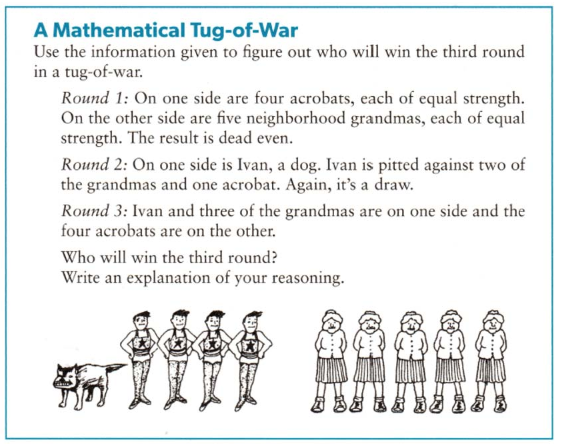
Following @mburnsmath on Twitter has paid off. This time the payment was an older task of hers, A Mathematical Tug-of-War. I did this task with my 7th graders, and while this may not have been the most difficult task I have ever presented, it may be the most accessible. When discussing this task during class with individual students and groups, I counted four distinctive approaches, with different variations of those four approaches present. I would categorize different ways as informal substitution, Algebra/combining like terms, unit rates, and assigning values (some of these overlap between the student work). I have examples of each posted at the end of the post.

Q1
Screen Shot 2017-01-16 at 7.31.20 AM.png
Can be found in 50 Problem Solving Lessons for Grades 1-6 Marilyn Burns Math Solutions Press 2003

Q2 What character(s) could you add to the losing side of round three to make the round a draw?

Q3 Dr. Edwards is teaming up with Ivan to form a tug-of-war dream team. Dr. Edwards is twice as strong as Ivan. You are forming your own team to tie Dr. Edwards and Ivan’s team. Give TWO possible team formations of Grandmas and/or Acrobats to TIE Dr. Edwards and Ivan’s team.

This is also a great example of a task that isn't necessarily real-world, but it is interesting for the students. Not everything has to be real-world all the time. The important thing is that the students are discussing the math involved. Maybe some will argue with me that this is real-world...I have seen a lot of wacky things on ESPN 2 late at night, but never the International Tug-Of-War Competition where animals and people are allowed to enter, although that would be interesting television. Same goes for this task...

A few of my students struggled to get started and were hung up on both sides needing to have an equal number of people in physical number and not in amount of strength. I gave the example of myself having a tug-of-war match with one of my student's kindergarten sisters. There would be one person on each side, but it wouldn't necessarily be equal. That worked well.

This task is also a good way to organically get away from a problem being on one side of the equals sign and one number being on the other side. The equal side doesn't necessarily mean question and answer like many students come to me thinking, but both sides being the same amount. When I previously taught 6th grade, problems like 3 + 5 - 2 = 1 + 1 + x would be difficult, and I think this task would help solidify what the equals sign really means.

I was disappointed that some of my students called me out on being as strong as two Ivan's, but in rethinking the reality of the situation, it probably depends on what four grandmas and what two acrobats I would be facing!


(The 100% reference loses its meaning after the first round, and we discussed that after this was submitted)

Other Task Posts Examples (more available in previous entries)...

Pokemon Go

Man Versus Squirrel

Shrinking Dollar

Tuesday, January 10, 2017

Toothpick Task 2017

I had an icy two-hour delay this morning, and when you operate off the a combination of getting to school by 6 every morning and living 40 minutes away from school, I never find out about the delay until after I arrive. I enjoy these mornings because I get to catch up on some work. I had a few students come in 3 hours before school started to work, I submitted a manuscript review for Mathematics Teaching in the Middle School, and worked on questions for an upcoming MTMS Twitter chat (which you should join the 3rd Wednesday of each month at 9ET/8CT with using #MTMSchat).

To the task...

Additional Information 

Q1~How many complete rows of toothpicks can you make with the amount given?
Q2~Will there be any extra? How many?
Q3~How many more would you need to complete the next full row?
Q4~How many toothpicks would the container need to create 20 rows?
Q5~If someone wanted to know how many toothpicks would be in the 75th row and you didn’t want to build that big of a pyramid, what could you do to find that answer fast? How do you know that will work?

The first part of this toothpick task (by @ddmeyer http://bit.ly/2jzv0sZ) begins innocently enough, with students trying to find out how many full rows could be made with the given amount of toothpicks. The interesting part to this is how students choose to solve this first problem. Almost all of the students (I did this with 7th grade, but could work for 5-8 or more). will start by dividing 250 by 3, not fully thinking what the result will mean. Once it is understood what this answer of 83ish means (asking a quick question about what does the 3 mean normally brings light to this problem), students branched off into three different ways to solve: a full blown picture, a chart, or a combination. Within these three options, most students either went with the tooth pick totals, or the total number of triangles. While many of these options will be similar, the different number of ways to solve this problem speaks to the accessibility of this task.

Question 5 is a great question as well because you can get into some generalizing. Some students automatically search for patterns, but some don't think of that as an option. Making it more explicit helps students understand that finding patterns is an option that can always be looked for. Patterns may not always be prevalent, but at least now students know that option exists.

This task will help us move into some tasks with some equation/expression writing built in such as Central Park, In-N-Out Burger, and Detention Buy-Out.

Enjoy the student work below! I especially like the one towards the middle where the students exclusively used triangles instead of individual toothpicks like many of the students used.

Note: As I was typing this, we are now cancelled :-(


Other Task Posts Examples (more available in previous entries)...

Pokemon Go

Man Versus Squirrel

Shrinking Dollar

Friday, December 2, 2016

Sticky Note Task Expanded

With my 7th graders, we recently finished the sticky note task, which is a compilation of tasks by Andrew Stadel and Jon Orr. I have done this in the past, but added the part by Jon this year. Surface area is probably the predominant math concept, but I found question 4 to be particularly interesting. Before we talk about that, here is the task...


Q1: How many sticky notes are needed to cover every exposed face of the cabinet?

Q2: How many pads would you need to have enough sticky notes?


Q3: How many sticky notes fit on the whiteboard?

Q4: If you had 120 of the 1.5 inch by 2 inch sticky notes, what is one size of board that you could cover (dimensions and area)?


Q5: What fraction and percent represents the following categories?
*Pink and blue Combined?
*All colors that are not pink or blue?


For question 4, students had a variety of amounts of sticky notes on the boards...anywhere from 12 notes by 10 notes to more of a ribbon board look of 120 notes by 1 note or 60 notes by 2 notes. The unexpected part for the students came when figuring out how much space the board they created took up. No matter the configuration of the 120 stick notes, the area of the board was always 360 square inches. This makes sense since all of the boards have the same number of sticky notes, and each note has an individual area of 3, but this took some time for everyone to comprehend. A great discussion piece for sure. 

The other thing I think was interesting about this task was if the students chose to find the sticky notes by finding the area of the board/face of the cabinet first, or find the number of sticky notes along the length and the width first. Some student did one method for question 1 and the other for question 3. 

This was a great task that would be appropriate for almost all levels of middle school. I have included some student work below. 

_


 _


_


_


_


 _


Monday, November 14, 2016

Mathematics Tasks for 2016-2017/The Pokemon Go Task

I've been doing a lousy job of blogging. I've thought to myself many times that I have no idea how I blogged in previous years. Last year at my university job, I always made a point to tell my preservice teachers just how much time and effort it takes to even do an adequate job teaching. I may have even underestimated that point, because clearly I forgot how much time this job takes up.

With that being said, I think it is important to get the tasks that my students have done this year out to other math teachers so they know what is possible. I have had multiple groups of teachers come into my classroom this year, and the comments are always the same...

1. I wish my students communicated like that...
2. I wish my students showed understanding like that...
3. I wish my students stayed on task like that...

I am very proud to hear these comments, and I always pass the kind words along to my students. One of the comments I don't hear are that my students are geniuses or rocket scientists. I am glad this is recognized by teachers as well, because teachers think that you can only do these tasks with the highest level of student academically (I've heard that comment many times at different presentations I have done). This certainly isn't true, because frankly a lot of my "lower level" students figure these tasks out faster than my traditional "successful" students. My students struggle in general with these tasks, but given time and the allowance of communication, everyone figures them out.

This process of getting students to communicate, show justification, and stay focused doesn't happen the first time you do one of these tasks. It's a process...sometimes even a slog. I think that problems happen when a teacher gives up on these tasks after the first try. You must keep plugging away. The benefits will far outweigh any struggles you have. All of these positives that teachers pick out carry over into everything else you do. These tasks aren't novelties, but an expectation of how everything should go in class. Even on days we don't do these tasks, my students display these desirable traits (for the most part...they are middle school students :-) ).

I think from here on out, I will post one task every so often, talk very briefly about it, and post some student work. Feel free to use these tasks, ask questions about these tasks, give suggestions to make these tasks better, etc. I will make sure to link where each task was adapted from so you can go right to the source if you wish.

I did the Pokemon Go task with my 8th grade students. I adapted this from Dan Meyer. I polled my students before I did this task, and only a small percentage had ever played Pokemon Go, so I was initially worried that some students wouldn't understand what I was going for. I ended up having very few question about the mechanics of the game, so don't worry about that. One idea that many student brought up after the fact was that we didn't calculate for the middle of the fan. I did not take this into account when I went through my task either, so I will have to account for it next time. As sad as the last two question are, they are both true depictions of my weekends these days. I have included a few pieces of student work along with my notes that I took the first time I prepared for this task. Hopefully I will have time to include these tasks a little more frequently, but here are links to both of my task pages for the year (updated as we do more tasks) in case you are curious what else we have done.

7th Tasks

8th Tasks

Task Nine ~ Pokemon Go (Dan Meyer)


Info Two ~  100000 cm = 1 km

Info Three ~ 1 mile = 1.61 km

Info Four ~ 1 mile = 5280 feet

Info Five ~ Each of the fan’s blades is 45 cm long

Info Six ~ The fan spins at a rate of 10 rotations for every 8 seconds

Info Seven Target Map

Q1 ~ How long would it take to hatch the 5 km egg using the ceiling fan?

Q2 ~ My daughter was sleeping in the car while my wife went into Target. If I stop the car, my daughter will wake up, so I kept driving around the Target building until my wife was finished. If I kept at an average speed of around 6 miles per hour, how many laps did I make in the time she was in Target if she was in the store for 20 minutes?

Q3 ~ I had my Pokemon Go app on as I was driving around Target (I wasn’t playing...it was just on). How many 2km eggs (I started with 4) did I hatch in the 20 minutes if all of my 2km eggs started at 0km?